
REVIEW · GUATEMALA CITY TOURS
Guatemala city Walking Tour and public bus
Public bus meets old Guatemala City. This tour is interesting because you mix a focused walking loop in Zone 1 with a real public ride, so the day feels both historical and practical. You’ll start near Avenida La Reforma and end at Plaza de la Constitución, with the city’s civic core and old-center streets along the way, plus a chance to finish with a coffee stop at San Martín.
I love the value here, especially since the public bus fare is included. I also like the way it’s built as a small-group circuit, max 15 people, so you get information without feeling swallowed by a crowd.
One thing to consider is that most stops are described from the outside and the admission tickets are not included, so if you want lots of interior museum time, you might feel a little limited. Also, the pace is not the fastest possible, and the first stretch can feel slower for some people.
In This Review
- Quick reasons this Guatemala City walk and bus route works
- Price and how you use it for real Guatemala City transport
- From Westin Camino Real to Zone 1, and why the start matters
- Stop 1: Estación Centro Cívico and the government buildings you can actually picture
- A guide’s Guatemala City story: Miguel Ángel Asturias and engineer Recinos
- Stop 2: Diario de Centro América and Tipografía Nacional, architecture with a timeline
- Stops 3 and 4: El Calvario (Nuestra Señora de los Remedios) and San Francisco’s rectory
- Stop 5: the Post and Telegraph building, Palacio de Comunicaciones under Ubico
- Stop 6: Casa Ibargüen, from Beltranena Palace to the Historic Capital Center
- Stop 7: Plaza de la Constitución, events and kilometer zero energy
- Stops 8: Metropolitan Cathedral of Santiago de Guatemala
- Stop 9: Mercado Central, the market built out of a messy old plan
- Stop 10: San Martín Centro Histórico for a coffee reset
- Pacing, heat, and what to bring so the day feels good
- Who this tour fits best (and who might want a different plan)
- Should you book this Guatemala City walk with public bus?
- FAQ
- How much does the Guatemala City walking tour and public bus cost?
- How long is the tour?
- Is the public bus fare included?
- Are admission tickets included for the sites?
- How big is the group?
- Where does the tour start and what time does it begin?
- Where does the tour end?
- What will I do at the end of the tour?
- What happens if the weather is bad?
- Can I cancel for a full refund?
Quick reasons this Guatemala City walk and bus route works
- Public bus included, so you travel like locals and save time compared to figuring it out yourself
- Max 15 people, easy start and end points, and a route designed to keep you oriented in Zone 1
- Concentrated landmarks in under a half-day, from government buildings to cathedral and the central market
- Market time that’s more than a quick photo stop, with a good chance to buy snacks and lunch
- A guide with real city experience, and you might even get stories like Armando’s background in firefighting or Fidencio’s calm, patient way of answering questions
- A coffee-friendly ending at San Martín in the historic center, so you don’t scramble for a place to sit
A day in the capital before you move on. More Guatemala City options
- PRIVATE SHUTTLE From Airport/Guate City to ANTIGUA or Vice-versa
★ 5.0 · 120 reviews - Lake Atitlán Sightseeing Cruise with Transport from Guatemala City
★ 4.5 · 87 reviews - Half-Day Guatemala City Tour
★ 5.0 · 82 reviews - Pacaya Volcano Tour and Hot Springs from Guatemala City
★ 4.0 · 75 reviews
Price and how you use it for real Guatemala City transport
At $30 per person, this tour is priced like a smart “orientation day.” The big reason it feels like good value is simple: the bus portion is included, not just the walking. In practice, that means you spend less time managing transit and more time seeing what you came for.
You’ll also cover a lot of ground for a short visit. The stops are clustered in and around the Historic Center and civic Zone 1, with enough variety that it doesn’t feel repetitive. I like this style when I’m in a new city: you get context early, then you’re freer to wander later on your own.
From Westin Camino Real to Zone 1, and why the start matters
The tour starts at the Westin Camino Real area on Avenida La Reforma at 10:30 am. That’s a helpful launch point because it puts you near public transportation and makes it easier to connect from your hotel or the rest of your day.
If you’re traveling with a bit of heat fatigue, plan for it. The day runs as a walking loop with brief stops, and Guatemala City can be warm. I’d bring a hat, sunscreen, and water, because you’ll want to stay comfortable while you move between stops.
Stop 1: Estación Centro Cívico and the government buildings you can actually picture
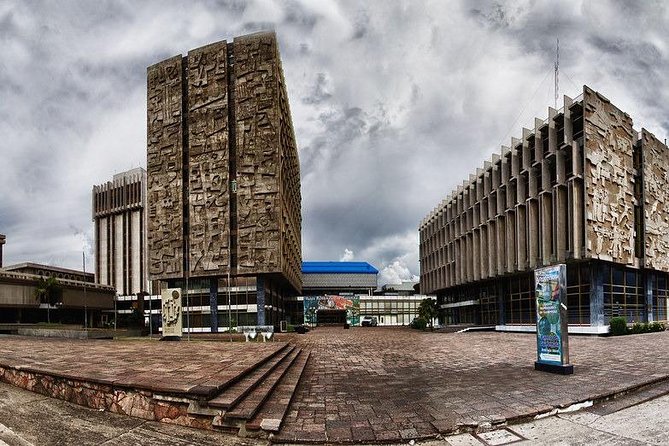
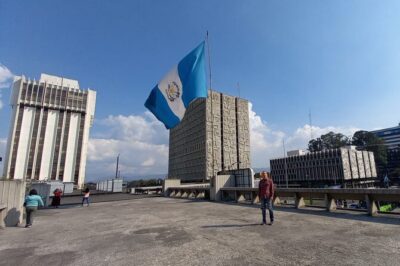
You begin at Estación Centro Cívico, with about 15 minutes focused on the civic skyline around you. The tour points out major buildings such as City Hall, Banco de Guatemala, Banco Credito Hipotecario Nacional, and the Social Security offices.
Why this works: it gives you a mental map of how Guatemala City organizes power and administration. You’re not just looking at pretty facades, you’re seeing the city’s “decision zone,” where government functions and major institutions sit side by side.
Quick consideration: this stop is ticket-free as presented here, so think of it as observation and explanation from the street rather than a museum-type visit.
More walks through Guatemalan towns
A guide’s Guatemala City story: Miguel Ángel Asturias and engineer Recinos
During this early segment, your guide shares an important behind-the-scenes detail tied to national culture. You’ll hear how an engineer Recinos was responsible for monitoring, construction, and creative development connected to what you now know as the Guatemalan Cultural Center Miguel Ángel Asturias.
It’s the kind of detail that makes a walking tour feel personal. You’re not only learning dates and names, you’re learning how projects get built and guided, and how that connects to the city’s identity.
Stop 2: Diario de Centro América and Tipografía Nacional, architecture with a timeline
Next is the Dirección General del Diario de Centro América y Tipografía Nacional, with about 20 minutes here. The story is built as a timeline.
You’ll hear that the first National Typography building was located from 1894 to 1918 on what was known as Hospital Street, specifically around 2nd South Avenue and 10th Street. Later, in 1935, President Jorge Ubico pushed for a new construction to support the operation.
Why I like this stop: it turns a building into a lesson about changing needs. Printing and communications were not always modern and centralized, and the move shows how national institutions expanded.
No admission tickets are included for this stop, so expect more street-level context than inside access.
Stops 3 and 4: El Calvario (Nuestra Señora de los Remedios) and San Francisco’s rectory
You’ll spend about 10 minutes at Parroquia Rectoral Nuestra Señora de los Remedios, also known as El Calvario. This place has seen multiple lives.
Originally, it was on top of Cerro del Cielito at the end of the sixth avenue in Guatemala City’s Historic Center. Then in 1936, it was converted into the National Museum of History. Later, it was demolished to extend one of the main roads.
Then you move to Iglesia San Francisco for another 10 minutes. This rectory is part of the parish of Our Lady of Remedies and is connected to the Franciscan friars in the Historic Center.
What you learn from both: you see how sacred spaces get repurposed and sometimes erased for infrastructure. That’s not pleasant, but it explains the city you’re walking through today.
Stop 5: the Post and Telegraph building, Palacio de Comunicaciones under Ubico
Stop 5 is about communications, and it’s a strong one. You’ll look at the Guatemalan Post and Telegraph Building, formerly known as the Palacio de Comunicaciones. This one is linked to the government of Jorge Ubico.
Designed by Rafael Pérez de León and Enrique Riera, construction started in 1938. Two years later, the first phase was inaugurated as part of a president’s birthday celebration, and then additional phases were completed over the next five years.
This stop feels more than “just an old building.” It’s about how a country tried to build systems that worked at national scale. If you like architecture that reflects politics and logistics, you’ll appreciate this one.
Again, admission tickets are not included, so treat it as an exterior viewing stop plus explanation.
Stop 6: Casa Ibargüen, from Beltranena Palace to the Historic Capital Center
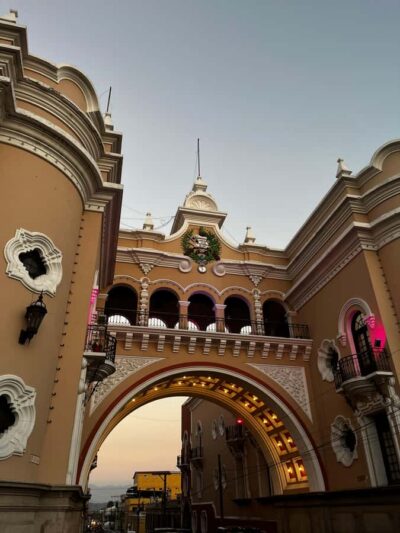
You’ll spend about 30 minutes at Casa Ibargüen in Zone 1. It used to be the Beltranena palace, built in 1778. Today, it’s the headquarters of the Foundation of the Historic Capital Center.
This longer stop length is telling. The tour gives you time here, which often means your guide has enough material to explain the building’s layered story. You get a direct contrast to the government and communications theme you’ve been seeing. This is older, more residential in feel, and it reminds you that the Historic Center wasn’t only administrative.
Because admission tickets aren’t listed as included, I would expect to focus on what you can see during the guided visit.
Stop 7: Plaza de la Constitución, events and kilometer zero energy
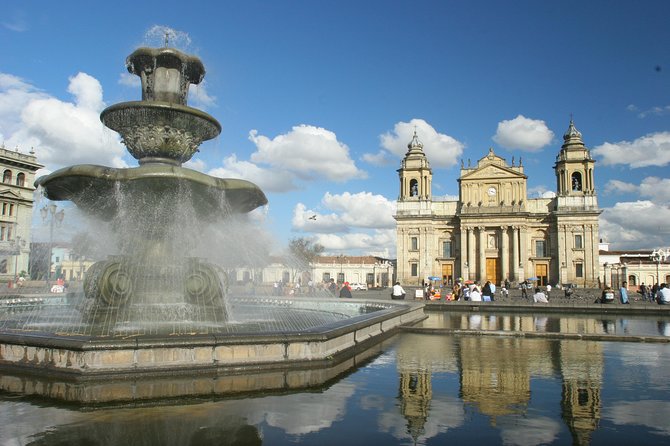
Then you step into Plaza de la Constitución, commonly called Central Park, and the largest square in Guatemala. The tour frames it as a hub surrounded by key landmarks: the National Palace to the north, the Metropolitan Cathedral to the east, the Portal of Commerce to the south, and to the west Centennial Park and the National Library of Guatemala.
Plan for about 15 minutes here. The guide also connects the plaza to national celebrations like Independence Day parades, plus concerts and speeches. There’s also mention of student demonstrations and protests, including comparsas and the Huelga de todos los Dolores parade tied to the University of San Carlos.
One practical detail that matters: the National Palace’s main entrance is kilometer zero for roads in the Republic of Guatemala. Even if you’re not doing road trips, it’s a fun way to understand how the city marks its national “starting point.”
Stops 8: Metropolitan Cathedral of Santiago de Guatemala
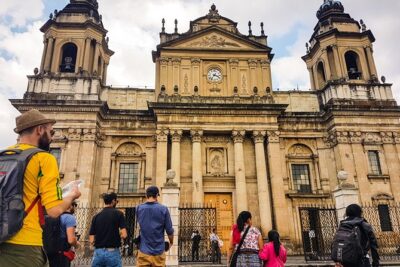
Your cathedral stop is about 15 minutes at the Catedral Metropolitana de Santiago de Guatemala.
The guide covers a long sweep of events over 200 years, including major earthquakes, independence, and a revolution. A specific note you’ll hear is that on July 23, 1860, a Carrara marble altar was placed in the cathedral.
This is the kind of stop where a good guide changes everything. If you care about how places evolve through disasters and political turning points, you’ll likely enjoy it more than if you were expecting only a quick visual scan.
No admission tickets are included here, so you’re mostly there for the guided explanation and exterior context.
Stop 9: Mercado Central, the market built out of a messy old plan
Next comes Mercado Central, with about 20 minutes. This is one of the more fun stops because it breaks the “monument-only” rhythm.
The tour explains how the market area developed near the cathedral. Before independence, there was an abandoned square called Plazuela de El Sagrario and a semi-destroyed temple serving as a chapel. There was also a cemetery, closed for excess burials after the capital moved to the La Ermita Valley.
Dr. Mariano Gálvez proposed converting the unhygienic area into a market that met public needs. That meant moving the cemetery to San Juan de Dios, but the work stalled when premature exhumations were blamed on morbid cholera. The church authorities also resisted because the location was sacred.
Why this matters to you today: this stop turns a market into a story about public health, politics, and how city spaces get redesigned. It’s also where you’ll likely want to buy something, whether that’s a snack or something for lunch later. Lunch isn’t included, but the market is exactly the kind of place where you can eat like a local with minimal fuss.
Stop 10: San Martín Centro Histórico for a coffee reset
Your tour ends with time to finish at San Martín • Centro Histórico. You’ll spend about 30 minutes here, and the plan is straightforward: grab a coffee cup and take a breather.
The tour points out that the old Pavón House on the Paseo de la Sexta and 10 street was revitalized to host a San Martín bakery and restaurant.
This is a practical choice at the end of a walking tour. After all that pavement and history, you get a comfortable reset point before you head back out. And if you’re still in the mood to wander, you can use the central location to plan your next stop.
Pacing, heat, and what to bring so the day feels good
The walk is designed as a half-day circuit, about 2 to 2.5 hours. Still, pacing is personal. Some people find the tour a touch slow overall, and the comment trend is that the second half feels stronger than the first.
My advice: don’t book this as a “speed run.” Book it as a way to get your bearings fast. If you pay attention to the stories, the extra minutes help the landmarks make sense.
Also, the city is hot. Bring a hat, sunscreen, and water, especially if you’re going around midday.
Who this tour fits best (and who might want a different plan)
This experience is a great match if you want:
- A guided orientation to Zone 1 and the Historic Center
- An efficient way to see major civic and religious landmarks in a short window
- Local transport included, which makes the day feel like more than a checklist
- A small group so questions get answered without chaos
You might want a different option if you:
- Want lots of paid interior attractions, because admission tickets are not included
- Prefer ultra-fast sightseeing with minimal explanation
- Don’t enjoy walking in warm weather
Should you book this Guatemala City walk with public bus?
Yes, if you want a practical, story-driven way to understand Guatemala City’s core. The value is strong for a single reason: you get a bus ride built into the experience, not tacked on. You also get a route that moves through major places like Centro Cívico, Plaza de la Constitución, the cathedral area, and Mercado Central, then ends in a calm spot for coffee at San Martín.
The guide quality also seems to land well. Armando gets singled out for being informative and friendly, and Fidencio is described as patient and welcoming, with a calm approach for families. With a 4.8 rating across 63 reviews and 97% recommended, this is one of those tours that tends to satisfy people who come prepared to walk and learn a bit.
One last check before you book: if you want lots of museum time inside, you’ll need to plan extra stops on your own. If you want a guided route that helps you understand what you’re seeing and then lets you explore freely afterward, this is a solid choice.
FAQ
How much does the Guatemala City walking tour and public bus cost?
It costs $30.00 per person.
How long is the tour?
It runs about 2 hours to 2 hours 30 minutes.
Is the public bus fare included?
Yes. Public transportation is included, so the bus fare is part of the experience.
Are admission tickets included for the sites?
No. Admission tickets are not included for the stops listed.
How big is the group?
The tour has a maximum of 15 travelers.
Where does the tour start and what time does it begin?
It starts at Westin Camino Realy, Avenida La Reforma, Cdad. de Guatemala 01010 at 10:30 am.
Where does the tour end?
It ends at Plaza de la Constitución (Central Plaza), at the address listed as JFRP+PQM, Guatemala City.
What will I do at the end of the tour?
You’ll finish with a moment to have a Guatemala coffee cup on San Martín in the historic center area.
What happens if the weather is bad?
This experience requires good weather. If it’s canceled due to poor weather, you’ll be offered a different date or a full refund.
Can I cancel for a full refund?
Yes, free cancellation is available. You can cancel up to 24 hours in advance for a full refund.
More Guatemala Tours
- Antigua Guatemala Full-Day Shared City Tour★ 5.0 · 84 reviews
- Half-Day Guatemala City Tour★ 5.0 · 82 reviews
- Hobbitenango & Antigua Shared Day Tour★ 5.0 · 81 reviews
- Mountain Bike Tour through Guatemala★ 5.0 · 76 reviews
- Lake Atitlan Day Tour from Antigua or the City | Boat & Villages★ 4.5 · 76 reviews
More Guatemala Reviews
- PRIVATE SHUTTLE From Airport/Guate City to ANTIGUA or Vice-versa★ 5.0 · 120 reviews
- Lake Atitlán Sightseeing Cruise with Transport from Guatemala City★ 4.5 · 87 reviews
- Antigua Guatemala Full-Day Shared City Tour★ 5.0 · 84 reviews
- Half-Day Guatemala City Tour★ 5.0 · 82 reviews
- Hobbitenango & Antigua Shared Day Tour★ 5.0 · 81 reviews
More Guatemala City Days
- PRIVATE SHUTTLE From Airport/Guate City to ANTIGUA or Vice-versa★ 5.0 · 120 reviews
- Lake Atitlán Sightseeing Cruise with Transport from Guatemala City★ 4.5 · 87 reviews
- Half-Day Guatemala City Tour★ 5.0 · 82 reviews
- Pacaya Volcano Tour and Hot Springs from Guatemala City★ 4.0 · 75 reviews
- Private Ground Transfer Guatemala City To Panajachel, LakeAtitlan★ 5.0 · 71 reviews
Recently reviewed: more ways to spend a day in Guatemala
Guatemala City Tours that cover the same ground.
 ★ 4.6From Guatemala City or Antigua: Pacaya Volcano Day TourFrom $9689 reviews
 ★ 4.5Lake Atitlán Sightseeing Cruise with Transport from Guatemala CityFrom $11987 reviews
 ★ 5.0Half-Day Guatemala City TourFrom $6082 reviews
 ★ 4.0Pacaya Volcano Tour and Hot Springs from Guatemala CityFrom $6575 reviews
 ★ 4.0Guatemala City Afternoon Sightseeing TourFrom $5865 reviews
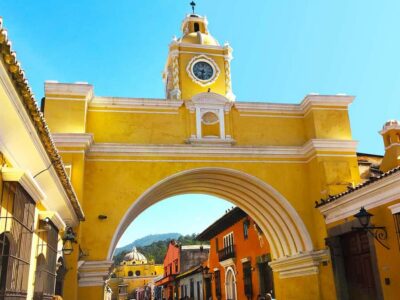 ★ 4.5Antigua Guatemala: Morning Tour from Guatemala CityFrom $3863 reviews
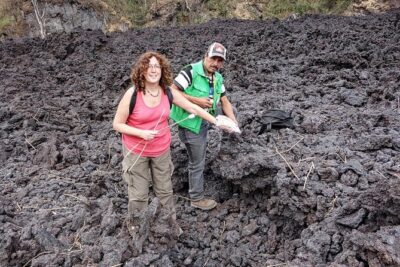 ★ 4.5Pacaya Volcano Day Trip from Guatemala CityFrom $9463 reviews
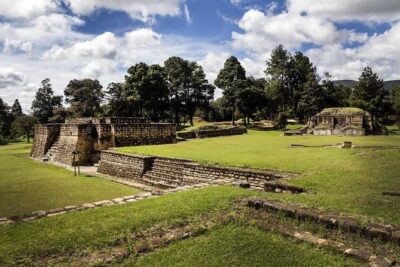 ★ 4.5Iximché Ruins and Antigua City Tour from Guatemala CityFrom $9461 reviews
Also on these pages